













Improving Your Relationship: A Happy Cat Expert Explains!
Do you feel that you have a good relationship with your cat? Or do you notice discomfort or tension during interactions together?
Getting to know your cat as a species and individual is essential to building and maintaining a good relationship. This in turn helps us to create a close bond. In this article, I am looking at how we can build that cat and human relationship together.
Cats and Humans: A Young Relationship
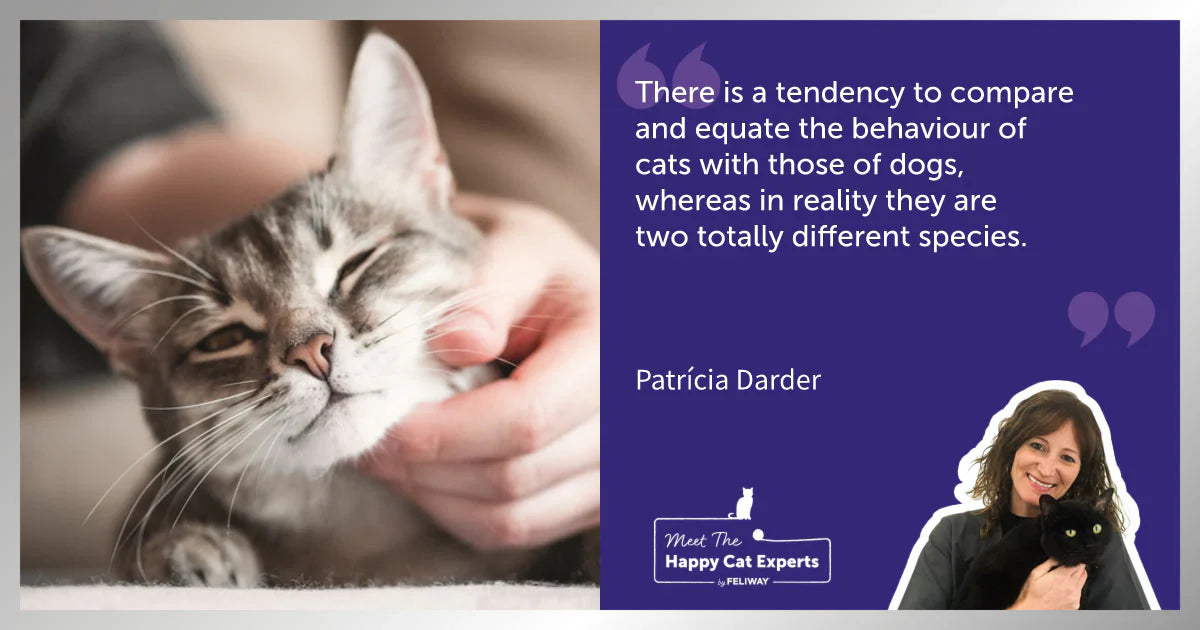
When adopting a cat, it is necessary to take into account the cat’s needs and characteristics as a species. You will also need to consider the limits of the cat-human relationship they will establish with people. There is sometimes a tendency to compare and equate the behaviour and traits of cats with those of dogs, whereas in reality they are two totally different species.
The first major difference is the length of domestication between cats and dogs. The dog, one of the first species to be domesticated, began to approach humans more than 20,000 years ago when we were still hunters with a nomadic lifestyle. Humans soon realised the different "uses" of dogs – for instance with help in hunting, guarding, and herding – and began to select them for different skills.

Cats and humans, on the other hand, have been around each other for a much shorter period of time. This is estimated to be around 10,000 years ago, when human as a species were already settling in different territories. Unlike the dog, the cat was associated with only a basic function – the protection of crops and food stores from rodents – and it similarly seems that cats were not always a well-regarded animal. For example, in the West, the cat was persecuted during the Middle Ages.
In short then, we can see there have been periods of time throughout history in which humans and cats have not been in close contact. What’s more, and unlike dogs, cats have not been an artificially selected species by humans until the modern era. Consequently, this reduced contact and influence between humans and cats – in both duration and intensity – has shaped a species with much less social tolerance towards people.
Are Cats Affectionate Animals?
Although cats form affectionate cat-human bonds, they also bond very strongly with their territory. In most cases, they tend to be very territorial and not so social, solitary animals. However, the degree of sociability towards people varies greatly from individual to individual. Thus, we find cats that seek a lot of contact and show frequent affiliative behaviour, and others that rather tolerate - but do not seek - proximity and contact. Factors such as socialisation in the early stages of kittenhood may influence this aspect. If this period of socialisation is done correctly, this will encourage the cat to show more social and affectionate behaviour towards humans in the future.

Know and Respect Your Cat
Taking all of the above into account, what can we do to have a strong and healthy relationship with our cats?
- Respect Their Personality: Firstly, respect your cat’s individual character and way of being. Remember that not all cats will feel comfortable if we cuddle them or want to touch them in every interaction, and doing so can harm your cat-human bond.
- Understand Needs & Feelings: Find out what your cat wants and how they feel in each situation. If you can identify their motivations and emotions, you will know your cat really wants to be with you and in what way. For instance, they may be content to just be close to you or maybe they will want to rest on your lap. For this, it is essential to know how to interpret the feline communication system and to have a basic understanding of their body language.
- Allow Choice In Interaction: Cats like to choose when and how to interact with their family. This helps them to feel safe and confident. So for example, if your cat doesn't ask you to interact, it is preferable not to approach or touch them when they are resting or not interacting with you. Wait for your cat to take the initiative and seek your affection, keeping in mind that interacting with your cat does not necessarily involve touching them. You can talk to them, look at them, or simply stay close to them – this can all help in building your cat-human relationship together.

- Preferred Contact Methods: In general, cats prefer gentle, brief, and frequent physical contact, and preferably around the head and cheek area. Your cat will probably feel more comfortable if you greet them with a few gentle strokes on the head rather than picking them up off the floor to cuddle them.
- Caring & Well-being: Meet all of your cat's physiological and behavioural needs. Make sure your cat has all the space, attention, and elements to be happy and to maintain an optimal level of well-being. If your cat is aware that you care for them and look after their welfare, they will develop a wonderful bond with you.